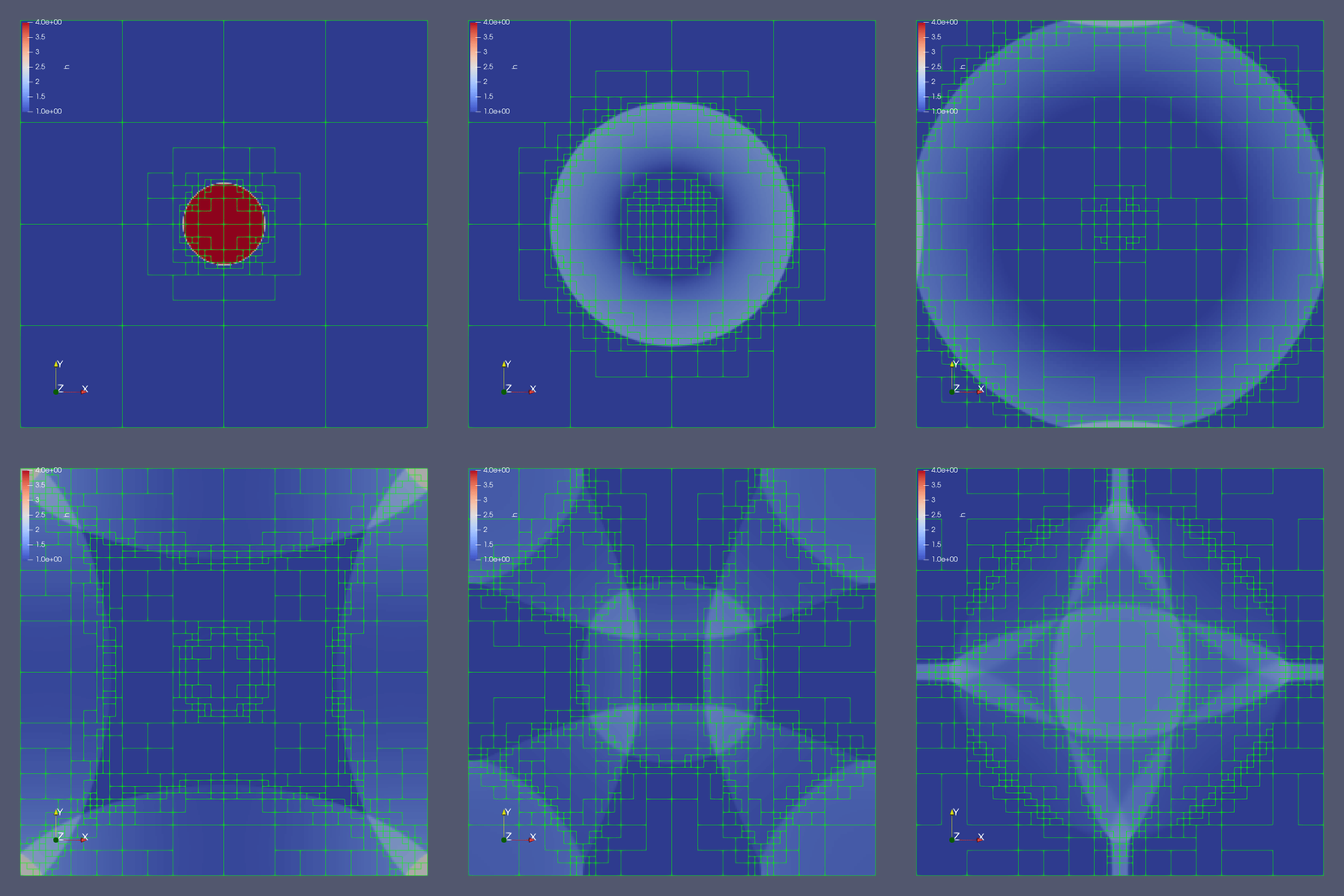
PyExner is a high-performance numerical framework designed to solve the coupled Shallow Water–Exner (SWE–Exner) system, enabling the simultaneous simulation of water flow and riverbed evolution. By leveraging modern high-performance computing (HPC) ecosystems, the project bridges the gap between rapid scientific prototyping and production-grade execution on GPU supercomputers.
5+ Publications
2 Citations
2 Codes Optimized for HPC Hardware
4 OSS Packages
Research & Work Highlights
A quick glance at my latest contributions and upcoming events.
Latest Project
All Projects →Featured Publication
All Publications → 2025
Towards Portability at Scale: A Cross-Architecture Performance Evaluation of a GPU-enabled Shallow Water Solver
SBAC-PAD
Show Abstract
Current climate change has posed a grand challenge in the field of numerical modeling due to its complex, multiscale dynamics. In hydrological modeling, the increasing demand for high-resolution, real-time simulations has led to the adoption of GPU-accelerated platforms and performance portable programming frameworks such as Kokkos. In this work, we present a comprehensive performance study of the SERGHEI-SWE solver, a shallow water equations code, across four state-of-the-art heterogeneous HPC systems: Frontier (AMD MI250X), JUWELS Booster (NVIDIA A100), JEDI (NVIDIA H100), and Aurora (Intel Max 1550). We assess strong scaling up to 1024 GPUs and weak scaling upwards of 2048 GPUs, demonstrating consistent scalability with a speedup of 32 and an efficiency upwards of 90% for most almost all the test range. Roofline analysis reveals that memory bandwidth is the dominant performance bottleneck, with key solver kernels residing in the memory-bound region. To evaluate performance portability, we apply both harmonic and arithmetic mean-based metrics while varying problem size. Results indicate that while SERGHEI-SWE achieves portability across devices with tuned problem sizes (<70%), there is room for kernel optimization within the solver with more granular control of the architecture specifically by using Kokkos teams and architecture specific tunable parameters. These findings position SERGHEI-SWE as a robust, scalable, and portable simulation tool for large-scale geophysical applications under evolving HPC architectures with potential to enhance its performance.
Show BibTeX
@inproceedings{Villalobos2025,
    title = {Towards Portability at Scale: A Cross-Architecture Performance Evaluation of a GPU-enabled Shallow Water Solver},
    url = {http://dx.doi.org/10.1109/SBAC-PAD66369.2025.00025},
    DOI = {10.1109/sbac-pad66369.2025.00025},
    booktitle = {2025 IEEE/SBC 37th International Symposium on Computer Architecture and High Performance Computing (SBAC-PAD)},
    publisher = {IEEE},
    author = {Villalobos, Johansell and Caviedes-Voullième, Daniel and Rizzi, Silvio and Meneses, Esteban},
    year = {2025},
    month = Oct,
    pages = {180–191}
}